How to identify the different Canadian Capitol records
Developed by Serge Pelletier
33 RPM Long Playing albums
identifying Canadian pressings
Canadian pressings can sometimes be quite confusing to identify since they are similar to US pressings in many ways. Nevertheless, A few specific details can easily identified to differentiate your Canadian and US Beatles and Capitol LPs. First off, LP labels are more glossy than US flat finish pressings (although some rare US pressings pressed by RCA are also glossy). But what really gives it away is the perimeter print that states MADE IN CANADA!
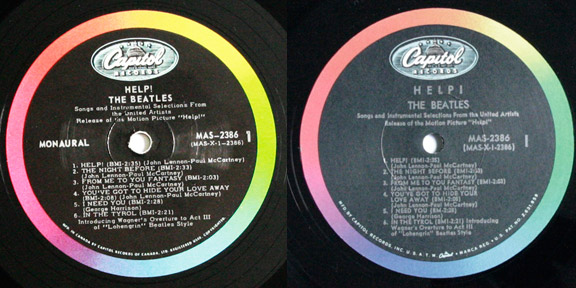
Canadian pressing on the left, and USA pressing on the right
Pressing Plants
In the USA, Capitol records were pressed by many pressing plants, from the east coast to the west coast. In Canada, on the other hand, Capitol records were mostly pressed by only two factories. RCA pressed all early Beatles albums until Compo was also subcontracted in 1964. Compo had a plant in Lachine near Montreal, but operations were already moved to Cornwall Ontario by the time A Hard Day's Night was issued (even though the cover states it was manufactured in Lachine). Pressing rings from the Lachine were actually different than the Cornwall pressing rings. Some albums were originally pressed only by RCA in Smiths Falls (Like Beatlemania, Twist And Shout and Long Tall Sally for example), and other albums were only pressed by the Compo pressing plant (Like Help, Revolver and Sgt Pepper's. Some other albums were pressed by both plants, like Rubber Soul, Magical Mystery Tour or Abbey Road. No plant had exclusivity on Beatles albums, until 1968 were all Apple albums were mandated to be pressed by Compo, with occasional support from RCA for rushes periods caused by new a new release. This means most Apple albums are pressed by Compo, and RCA Apple albums are made in much smaller quantities, and mostly only for early releases.
Later, in the 70s, other companies were subcontracted to press Beatles records. RCA switched to their thin Dynaflex pressings, while Columbia pressed many albums for Capitol in the early 70s and in the 1980s. In 1976, Capitol started pressing its own records in its new Mississauga facilities, which lasted until 1983. Finally, other companies, like Keel and Cinram pressed a few rare Beatles albums in the late 70s and early 1980s. Non Capitol albums were also pressed by Compo (Polydor and ATCO), while other albums were pressed by Quality Records (MGM and METRO).
Pressing Rings
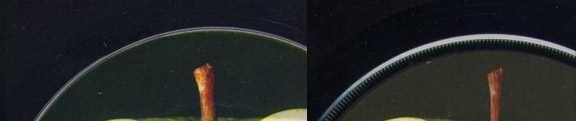
There is a way to identify these pressing plants, and this is called the pressing ring. Each pressing plant uses different equipment that leave a mark on each record. These marks are in the shape of a ring on the label around the spindle hole. These rings vary in size, from around 1 to 3 inches. So, labels with a large carved groove originate from the RCA pressing plant in Smiths Falls, Ontario. Compo pressings from Cornwall instead have a small raised ring measuring around 3/4 inch. Capitol Mississauga pressings have a ring halfway in size between the Compo and RCA ring. Pressings originating from the Columbia plant, on the other hand, have a large ring similar in size with the RCA pressing, but is a very small raised groove instead of a carved groove. Finally, Quality Records pressing rings are almost identical to RCA rings, but are not as harshly carved (they seem slightly smoother to the touch).
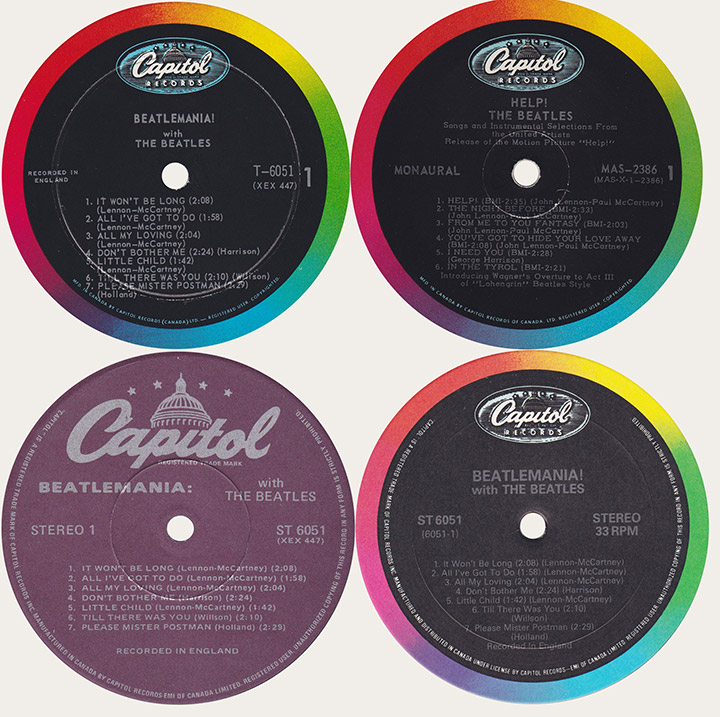
Top left: RCA pressing, Top right: Compo pressing
Bottom left: Capitol pressing, Bottom right: Columbia pressing
Some odd RCA pressings seem to have a one-sided groove. These were thought to be Columbia pressings, but are in fact "faulty" RCA rings. These are the result of either human variance in the pressing process, or temporary replacing parts. Either way, they are RCA because many albums have a normal ring on one side, and the faulty ring on the flip side. Also, it would not have made sense (commercially) to send over pressing parts (or half the parts) to Columbia to press a very small number of copies.
Matrix Information
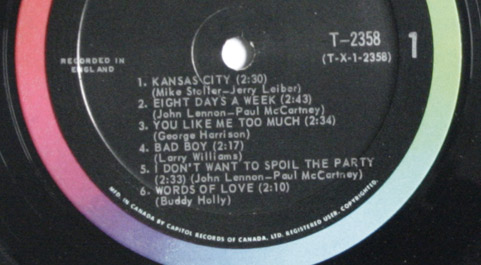
Etched in the dead wax of every record can be found the matrix information. This information gives very precise insight on the details of the pressing; from sound spectrum, pressing generation, to tape source and master source. Metal masters used to press the records were always made from either tapes sent from the US or UK to Canada, or sent directly from the USA (also made from master tapes sent from the UK). Records made from metal parts sent from the USA have machine stamped matrix info, while masters prepared in Canada are hand-written. Canadian masters for the first three albums are identical to the UK tapes and albums, while American tapes were often tweaked by adding echo and different stereo separation. Matrix info with UK numbers like XEX 447 are made from UK tapes, while numbers ending with the letter J (SWBO-101 J43 for example) were tweaked in L.A. before being sent to plants across North America.
Perimeter print
Another tool to date your albums is the perimeter print. The company was forced to change its legal information from time to time. For example, pre-1966 pressings have a legal information stating MANUFACTURED BY CAPITOL RECORDS OF CANADA LTD. On September 15 1965, Capitol Records of Canada was re-incorporated as CAPITOL RECORDS (CANADA) LTD. - DISQUES CAPITOL (CANADA). All pressing after 1966 therefore bear this new "Brackets" perimeter print. Changes like this occurred a few times in the 1970s and 80s, making it easy to accurately date every pressing.
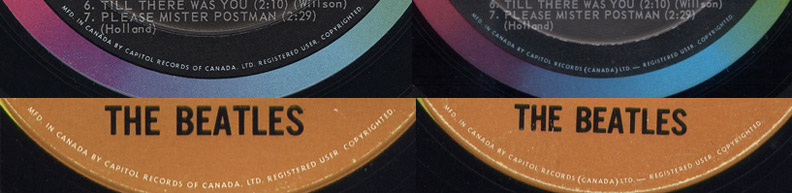
Different labels
Like every company, Capitol changed its corporate image from time to time, offering new label and logo designs. These occured on very specific dates and allows to date records. These started with the black rainbow label, and saw new designs starting in 1969, from green and red target labels, orange and purple labels, and later a retro rainbow label. Details on these label changes can be found on our Beatles Labels page.
Capitol's catalog numbering system
Capitol had a specific system to code their LP releases.
Each letter referred to a particularity of the record (price codes, Mono, number of LPs in the album etc.)
They used between 1 and 4 letters before the number.
Although not absolute, it is believed to work like this:
The first letter
S = stereo
D = duophonic
blank = mono
The second letter refers to the price code
T = regular price
K = regular double album price (gatefold)
E = specialty price (coloured vinyl)
M = specialty price (single album gatefold)
O = specialty price (custom)
The third letter
A = single album
B = double album
C = triple album
The fourth letter
(many unknown letters of this section here need to still be identified)
L = libretto/book
S = ?
B = ?
O = printed inner sleeves
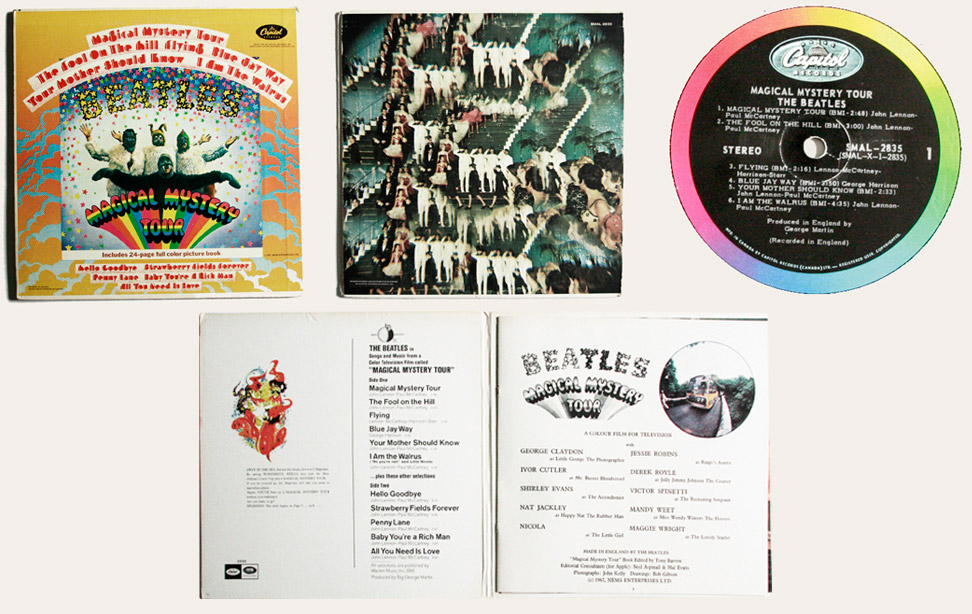
So for example, the Beatles' Magical Mystery Tour album numbered SMAL 2835 means it is a STEREO album, single album gatefold, with ONE record inside and includes a libretto.
45 RPM Singles
identifying Canadian pressings
Like LPs, Canadian 45s have glossier labels, and a Manfactured in Canada perimeter print. Apple discs on the other hand, are very distinctive in the fact that the flip side label information is printed sideways, while in the USA, all discs have the information pressed vertically (except for 1 or 2 titles). Besides a specific generation of orange labels, Canadian singles do not feature a bumpy ridge on the outer edge of the label.
Pressing Plants
The same pressing plants that pressed LP also 45s, subcontracts were signed for both LP and 45s. Compo and RCA were mandated in the 60s, and Capitol and Columbia pressed records in the 1970s and 1980s.
45s do not have pressing rings, but they still bear differences allowing to identify RCA and Compo pressings.
45 RPM singles pressed by RCA
The loop of "L" in the capitol logo is FULL on the swirl labels
The font used on Apple singles is small and round. (The font used on swirl labels is the same as Compo swirls)
The word STEREO usually appears on the bottom right, under the credits on stereo Apple singles.
45 RPM singles pressed by COMPO
The "L" of the Capitol logo has an OPEN LOOP on swirl labels
The font used is much bigger in size, and is condensed. Compo used the same font for swirl and Apple labels, unlike RCA.
The word STEREO usually appears on the top left, near the title, on stereo Apple singles.
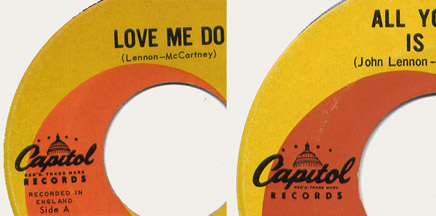
RCA pressing on the left, and COMPO pressing on the right
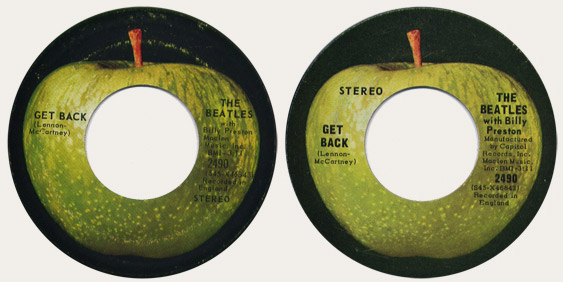
RCA pressing on the left, and COMPO pressing on the right
Matrix Information
For 45 RPM records in Canada, masters were made from either 2 different processes.
First process: they were sometimes dubbed directly from the foreign single instead of getting master tapes from the UK head office ("Capitol 72076 Love Me Do" is a good example). In these cases, the original matrix number from the imported single was used.

Otherwise, they would create a single from the LP master tape they had previously received from the UK or the USA (eg Roll Over Beethoven from the UK master tape of Beatlemania).
When masters were indeed created from master tapes, the matrix number would then have a "CC" prefix, meaning "Canadian Capitol".
Capitol 72146 Twist And Shout is a good example with its matrix number "CC1 CC2 -72146-52". But the use of CC was not always followed.
NOTE: Rarely did Capitol of Canada just get a master tape for a single. In fact, EMI never sent master tapes for singles.
Capitol USA did however send a few metal stampers, usually from the Scranton pressing plant. When this is the case, we can see the triangular IAM logo stamped in the trail-off area. IAM stands for "international association of machinists". This logo was pressed on every US Scranton pressing.
Perimeter print
Perimeter print information were identical for 45s and LPs. (See above LP entry)
Different labels
Details on 45 label changes can also be found at the bottom of our Beatles Labels page.